
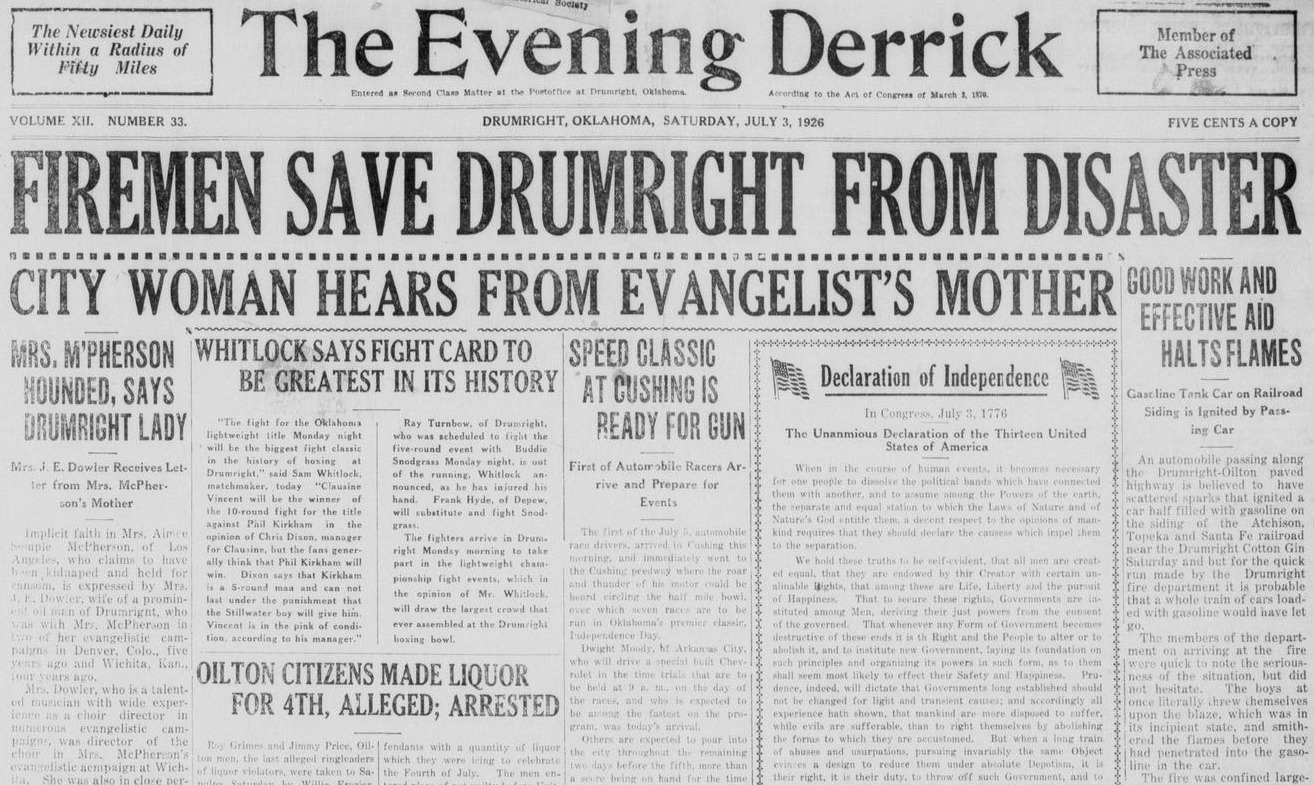
Archived pages of The Evening Derrick show a young city shaped by railroads, oil, fires, boxing, baseball and everyday grit
DRUMRIGHT — A century ago, Drumright’s Fourth of July message was simple: celebrate, but be careful.
In the July 1, 1926, edition of The Evening Derrick, a boxed holiday notice reminded readers that the nation was preparing to mark the 150th anniversary of the signing of the Declaration of Independence. The message urged residents to make it a “Glorious Fourth” and a “Big Fourth,” but also a “Careful Fourth.”
Fireworks, the notice said, could add joy to the day when used properly. Parents were warned not to give fireworks to very young children, not to allow children to put fireworks in their mouths, and to avoid toy pistols, explosives and blank cartridges.
That warning was not just holiday filler. On the same front page, the paper reported that 5-year-old Arthur Burton had lost sight in one eye after a torpedo exploded while he was playing with companions. The accident happened just days before the Fourth, making the holiday safety message feel immediate and personal.
The Drumright of 1926 was a busy, young, oil-field city where celebration and danger often shared the same front page.
The Evening Derrick sold for five cents a copy and advertised itself as “the newsiest daily within a radius of fifty miles.” Its July pages show a city plugged into oil, rail, commerce, sports, politics and civic growth. Headlines moved quickly from fireworks safety to bank robbery arrests, oil-field explosions, downtown raids, court cases, mail service, baseball games, fire calls and Chamber of Commerce reports.
The city was still young enough to remember its own beginnings clearly. A July 1 story noted that the Santa Fe line’s first train had arrived in Drumright 11 years earlier, connecting the city to the outside world and helping fuel its growth around what the paper called the world’s greatest oil field. Rail service was not just transportation. It was a marker of Drumright’s rise.
Mail service was also front-page news. The July 1 edition reported that Drumright’s mail service was to be resumed after transportation bids were received. The story listed the mail route schedule between Tulsa, Cushing, Drumright and Oilton, a reminder of how closely the area’s towns were tied together.
Stores planned to close for the holiday, and the paper announced there would be no Monday publication because Independence Day fell on Sunday and was being observed the following day. But the holiday did not slow everything down. There were races, fights, dances, theater shows and sports.
One front-page headline promoted a “speed classic” at Cushing, where auto races were planned for July 5. Another promoted what was billed as one of the biggest matches in Oklahoma history, a lightweight boxing contest involving Vincent Kirkham and Clausing. Baseball also had its place, with the Drumright-Oilton team and the Drumright Independents making the sports columns.
The holiday weekend also showed the constant threat of fire in an oil town. On July 3, The Evening Derrick carried the massive headline, “Firemen save Drumright from disaster.” The story described a gasoline tank car fire near the Santa Fe railroad tracks and the Drumright Cotton Gin. Firefighters contained the blaze before it could spread, and the paper credited quick work and effective aid with preventing a much larger disaster.
Nearby, another headline reported that bodies of fire victims were to be laid to rest. A later edition reported that two people had died in an explosion northeast of Cushing. The oil patch brought opportunity, but the newspaper pages show it also brought danger that residents lived with daily.
Drumright’s civic life was active and ambitious. One July 6 headline reported that more dwellings were the city’s great need, according to a Chamber of Commerce secretary’s report. The report pointed to highway building, agricultural development, oil-field work and business growth as signs of progress, but also emphasized that housing was needed if the city was to keep growing.
Other stories focused on schools, churches, countygovernmentandpublicmeetings.Plans for a school association were being studied. Creek County tax valuation was reported at $50 million. County commissioners, oilmen, attorneys, merchants and civic leaders filled the columns.
The pages also show a lively business community. Ads promoted dentists, banks, building and loan services, tire shops, used cars, clothing sales, drugstores, Sunday dinners and local entertainment. A Boston Store ad promoted a July Fourth sale. Runyon’s Club advertised a big attraction at the Strand. A Waffle House ad promoted Sunday dinner, complete with fried chicken, dressing, potatoes, pie, ice cream and vegetables.
Crime was part of the picture, too. The July 6 front page led with “Tulsa bandits stage down-town raid,” while another story reported messengers in a business area had been robbed by two men. Smaller columns carried reports of arrests, jailings and court activity.
But taken together, the pages do not show a town defined only by danger or disorder. They show a place in motion.
Drumright in 1926 was young, loud and industrious. It was a town of oil wells, rail lines, boxing cards, baseball games, church meetings, store closings, chamber reports, fire alarms and holiday warnings. It was still close enough to its boomtown beginnings that the arrival of the first train remained part of living memory, but established enough to argue over housing, schools, roads and city progress.
Its Fourth of July was not built around one polished community festival the way later celebrations often would be. Instead, the holiday appeared across the paper in pieces: a safety warning, closed stores, no Monday edition, races, boxing, dances, travel, fire calls and family gatherings.
A century later, those pages preserve a vivid picture of Drumright as it was in 1926 — patriotic, practical, dangerous, ambitious and full of people working to turn a fastgrowing oil town into a lasting community.