
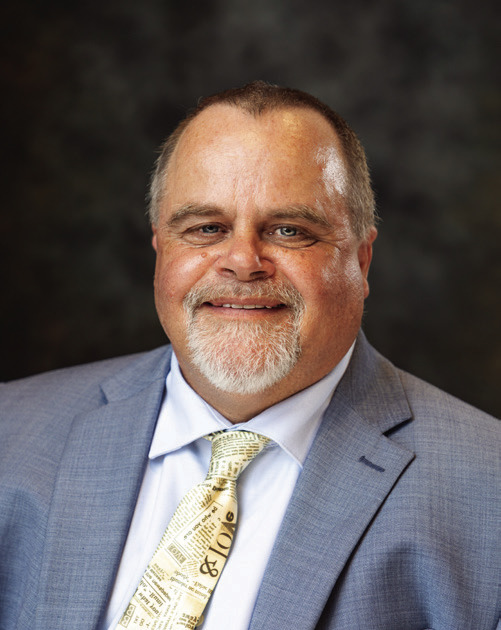
Publisher, Bottle Washer and Occasional Newspaper Delivery Guy
And now, readers, introducing J. D. Meisner! Owner! Publisher! Former hot air balloon pilot! A man who can make an earth-shattering business decision in the morning and spend the evening wanting to beat the bajeezuz out of a cantankerous labeling machine.
For Newspaper Week, we gave J. D. the 20-questions treatment. His answers reveal a life filled with newspaper ink, mountain adventures, family and a deep, abiding resentment of laundry.
First, the credentials. His honors include Editor & Publisher magazine’s Top Ten Publishers Who Do It Right, the 2018 ONG Editorial Writing Sweepstakes Award, Sequoyah Awards for The Yale News and The Keystone Gusher, and first-place awards for photography, ad design, sports writing and column writing in the Oklahoma Press Association’s Better Newspaper Contest. He also belongs to OPA’s Quarter Century Club.
He is president of the Oklahoma Newspaper Foundation and a member of the Cushing Rotary Club, Oklahoma Press Association and National Newspaper Association.
And what does this decorated publisher do all day? “There really isn’t a typical day, which is one of the things I like about the newspaper business.”
He might start the morning working with the editor on coverage, then move to advertising, the printing contractor, stringers, circulation, a football game or building a Smartypants page and managing its subscriptions, “all while whatever fresh disaster has wandered in off the street waits impatiently for its turn like a grandkid hungry for ice cream.”
As publisher and owner, he’s involved in every part of the operation.
“We meet in our fancy little conference room, plan special publications, review stories and layouts, keep an eye on the business side and spend a lot of time figuring out how to better serve our communities while keeping local journalism financially sustainable, which is a polite way of saying we try to do good work without setting fire to too much currency.”
One day a week, he also labels and delivers newspapers. “That probably sums up small-town publishing pretty well. One minute you’re making earth-shattering business decisions, and the next you’re standing over stacks of newspapers, wanting to beat the bajeezuz out of a cantankerous labeling machine.”
Some days involve writing or editing. Others bring conversations with business owners, production issues, project planning or something nobody had on their bingo card.
“Mostly, my job is figuring out what needs to happen next and making sure it happens. Fortunately, we have a fantastic team, so a surprising amount of good management is knowing when to delegate and when to get out of the way so you don’t become the problem yourself.”
His explanation to a friend is equally practical. “I’m part publisher, editor, salesperson, production manager, problem solver and, one day a week, newspaper delivery guy. Basically, if there’s a job nobody else has claimed yet, there’s a decent chance it now belongs to me.”
He lends his experience to coverage, helps local businesses reach customers with their best message and looks for ways to keep journalism working “in a world that keeps changing the rules.”
“Sometimes the glamorous life of a publisher involves strategy and quick thinking. Sometimes it involves the smell of ink, burnt coffee and a late night labeling newspapers for delivery.”
Now, readers, let us rewind. In December 1991, “while between dysfunctional odd jobs,” J. D. became a cub reporter at The Beacon. Six months later, his editor died suddenly, and the publisher asked whether he could serve as interim editor until someone else was found.
“I stayed as editor for the next 11 years, covering everything from tragedies to heartwarming stories and everything in between. Journalism seeped into my blood.”
But his first contact with newspapers came much earlier. At about 11, in his hometown of Grants, New Mexico, he rode his bicycle to the local paper after school, bought 50 copies of the Grants Daily Beacon for a nickel apiece and rode two blocks to the Piggly Wiggly to sell them for a dime.
“Pretty darn good pay for an 11-year-old kid in the mid-’70s.” What keeps him in the business is knowing the work matters. “Ournewspapersaremorethanjuststoriesandadvertisements. They are a record of the people, events and moments that make up a community, which is a lot more meaningful than simply filling pages every week and hoping that nobody knows about the deadline train wreck behind them.”
Sports coverage is especially rewarding. He watches young athletes grow up through the pages: first varsity starts, big plays, heartbreaking losses, undefeated seasons and everything in between.
“Years later, those stories and photographs become part of that person’s history, of their community’s history. That is pretty special, even if, at the time, I was mostly worried about getting a good in-focus shot, the names spelled right and remembering which kid was wearing No. 12.”
Beyond sports, local news helps people understand their towns and become involved. It records their accomplishments, businesses, struggles, celebrations and everyday lives.
“We are not just reporting on these communities from the outside. We are part of them. Our job is to support them, document them and make sure their stories are accurately told and preserved, preferably with the names spelled right.”
The hardest part is reporting on preventable tragedy: a drowning where a life jacket wasn’t worn, teenagers killed in an ATV accident without helmets, a loss that might not have happened with one better decision.
“In small communities, losses like these do not affect just one family. They ripple through schools, churches, teams, workplaces and neighborhoods. Often, we have watched these young people grow up through the lens of our own coverage, then suddenly we are writing a story no one ever wanted told.”
Those stories stay with him. “Tragedy is an unfortunate chapter of any community’s story, but it is important enough to be told accurately.”
Readers might be surprised by the size of the operation: three newspapers, a weekly online magazine, three glossy magazines, special publications and the nationally syndicated Smartypants kids page, produced by five full-time employees and three contract employees.
“We have a fantastically talented team.” His unexpected professional skill? Diplomacy. Hands down. “I went into this business knowing it was about reporting facts, taking great photos and selling ads. But wait ... there’s more! Turns out a surprising amount of it is telling people things they do not want to hear, listening to people tell me things I do not want to hear, and being able to finish this kind of conversation without causing a blood feud.”
He has learned to ask uncomfortable questions, give uncomfortable answers and listen while someone boiling mad talks themselves down “to a more manageable simmer.”
“I used to joke that being a newspaper editor was having half the town mad at me and ensuring it is never the same half every week.”
Publishing, he says, means working to keep the town respecting what the newspaper stands for, even when people disagree.
His preferred title is bottle washer. “I just point and make suggestions, locate extra extension cords when needed, keep everyone in sync, and occasionally put out proverbial fires.”
And now, the scenery changes to the high desert. Born and raised in Grants, J. D. grew up outside town at about 7,000 feet, surrounded by sandstone cliffs, endless lava flows and 11,300-foot Mount Taylor. He and his father spent fall and winter hunting deer, elk and turkey in the high country.
On his dad’s hobby ranch, he rode horses, fed livestock and learned the value of hard work.
“Like most kids, I took the beauty around me for granted. It was simply home.”
Only after moving away did he recognize how extraordinary it was.
His crew today is his wife and family. “MaryLee and I are best friends. All we need is each other and our kids and grandkids.”
His ideal day off? “On the pontoon, it’s maybe 78 degrees out. I’m floating Keystone Lake with MaryLee, a half-full cooler, a live well full of fish, the hum of the Mercury outboard ... and more light at the end of the day.”
Home, however, is more than one place. Sometimes it is Grants: horses in the cold morning air, rain on sage, piñon smoke and green chile roasting in the fall. It is his father teaching hard work, responsibility and caring for what had been entrusted to him.
Later, it became the house where he and MaryLee raised their family.
“It became muddy shoes by the door, kids that were not ours raiding the kitchen, birthdays, arguments, Christmas mornings, youth sports, worry, laughter and all the ordinary moments that somehow become the ones you miss most.”
Then came seven acres in Tryon, raising Allie, welcoming other children, band trips and exchange students. It became the place their children could return when they wanted or needed them, where grandchildren arrived and where their youngest daughter chose to marry.
“The older I get, the more I understand that home is not about geography.
“It is New Mexico and Oklahoma. It is snowy mountains and bass-filled lakes. It is children and grandchildren chasing fireflies. It is every place where our family has laughed, struggled, forgiven and kept going.
“But most of all, home is MaryLee. Wherever she is, putting up with me, loving me, that is home.”
For a little movie magic, he would revisit his first experience of the original “Star Wars,” “A New Hope.” He was 13 when it came out and figures he watched it 15 times that year.
“That first experience was magic.” For a new adventure, he’d try skydiving. For the dream garage, there are two contenders. The dailyish driver is a cobalt-blue 1971 Malibu SS convertible with a 454-cubic-inch LS5 big-block V-8 and factory white racing stripes over the hood and trunk.
The collection’s first addition would be a silver 1963 Corvette Stingray split-window coupe, with a fuel-injected 327 and matching numbers.
“Just a thing of beauty. I’d be afraid to drive it.” Childhood returns through freshly broken alfalfa bales, sweaty horses and manure.
“When I smell those smells, I am transported right back to 12-year-old me who rode fence on weekends, shoveled out corrals and stalls, helped butcher pigs and brand and cut steers. Hard work, but it was wholesome and looking back, I had no idea how lucky I was to grow up that way.”
At 8, he idolized his dad and wanted to be like him, although cars and racing also fascinated him. Would that boy approve of grown-up J. D.?
“I’d probably be most impressed by the fact that grown-up me had an old tractor to drive around.”
A favorite project was buying the old Hawthorn Dentistry office at 120 E. Broadway with MaryLee and working together to gut and renovate it into their publishing workspace. His favorite annual publication is the Keystone Lake Guide.
The behind-the-scenes photograph he wishes existed comes from covering the Mount Taylor Winter Quadrathlon, a February endurance race involving cycling, running, Nordic skiing and snowshoeing from town to the mountaintop.
The year he covered it from the summit, a blizzard arrived with sustained winds of 40 to 50 mph and a wind chill around 30 below zero. They dug snow caves below the summit on the leeward side to avoid freezing. The race continued while he and Albuquerque Journal photographers struggled to keep their cameras working.
“It was absolutely the nastiest weather I’ve ever been in and would have made a pretty good documentary.”
His greatest pride is closer to home. “The fact that MaryLee and I raised three intelligent, successful, capable kids without killing each other.”
His hobby is fishing. Always fishing. And perhaps a few evening hours of Fortnite.
“Yes. Video games. It’s my kids’ and grandkids’ fault, but blowing up anonymous preteen kids in a video game somehow helps me unwind in the evenings.”
His choice for a magically eliminated chore requires no deliberation.
“Laundry. Freaking laundry. It’s the scourge of our existence.” And one final detail before our publisher leaves the stage: He is a former hot air balloon pilot who flew in the Albuquerque International Balloon Fiesta and participated in its recordsetting 1,000-balloon launch on opening morning in 2000.
“Beautiful to watch, chaotic to fly.” There you have him, readers: J. D. Meisner! Keeping the team in sync, the newspapers moving and the community’s stories preserved, preferably with the names spelled right.