
“I was support for those that had to face it”
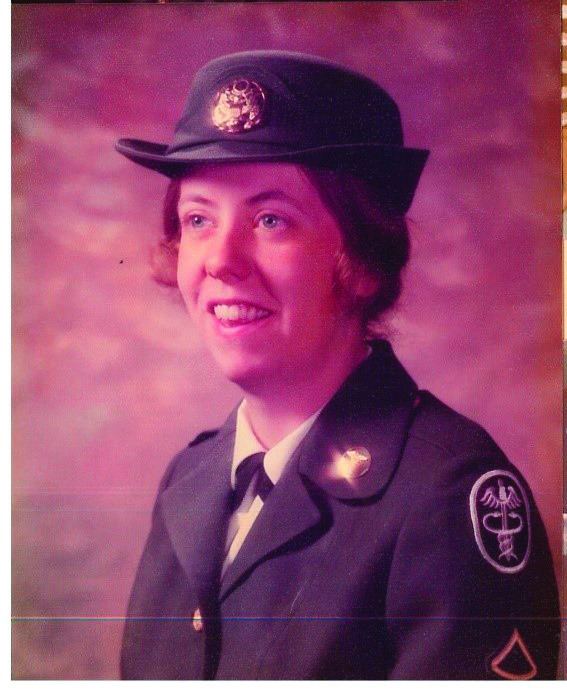
When Evelyn Ferchau raised her right hand to enlist in the U.S. Army in 1974, she never imagined it would lead her to the edge of the Iron Curtain or, perhaps even more surprisingly, a lifetime of honoring those she supported as a medic. She shared her journey from a small-town Michigan classroom, to an Army base near the Soviet border, and finally to her continuing mission to preserve Veteran stories as the historian for the Cushing-Drumright American Legion Post 108.
An Artist Turned Medic
Born in Highland Park, Michigan, Ferchau was the youngest of seven children and as she puts it, “truly the baby” as her closest sibling in age was already 18. Her parents were divorced when she was four, resulting in her growing up quite differently from her older siblings. She recalled moving with her mother to her grandparents’ house and said she was fortunate to have three adults encouraging her education and creativity.
“I really had a good childhood,” she said. “I had three adults to take care of me and I did well in school.”
A statement that was evidenced by her graduating at the top of her Kingston High class and earning a Daughter of the American Revolution (DAR) scholarship to attend Central Michigan University. She majored in art education but a distressing experience while fulfilling her student teaching requirement sent her down a different path.
“A boy pulled a knife on me and so after that I decided I didn’t want to be a teacher,” Ferchau said. “I was good at the art part but the discipline part wasn’t really me I guess.”
She graduated from college with a degree in art and a degree in secondary education but instead worked several odd jobs — from factory work making RV curtains to sorting out bad eggs as an egg candler. However, hearing of a new opportunity would lead her to signing up for military service.
“I heard that if I joined the military that they would pay whatever educational debt I had and so I committed to two and a half years so I could get that paid,” she revealed.
Ferchau enlisted in the army in November of 1974, entering as a Private First Class (PFC) E-3 thanks to her college degree. While high scores could have afforded her the opportunity to go into Officer Candidate School at some other point when she enlisted, that option was closed so she was instead told she could go where she wanted or do what she wanted. “Since I had a lot of art history I wanted to go to Europe so I could see everything that I had studied,” she said. “They made me a medic which was so far from art — I did not expect it.”
A Medic Turned Wife
Ferchau was trained as a medic at Fort Sam Houston in Texas. She went through basic training at Fort McClellan, Georgia. It was during basic training she was awarded an Expert Rifle Badge. She recalled what she referred to as the “funny story” of how she earned it.
“When we went out to the firing range we did it for two days. The first day I did really bad but that afternoon, I had to go for an eye appointment and they gave me glasses. The next day when I went I got an expert rifle badge,” she laughed.
Ferchau was eventually stationed in Germany near the Soviet border. Although her clerical skills led to her primarily working away from the frontline in administrative roles, service was not without its intense moments. She explained what would happen when the unit was placed on red alerts which would occasionally happen after sensitive information was suspected of being revealed.
“A red alert meant that we had to go to the medical unit into the field and the whole set up was just like what was shown on M*A*S*H,” Ferchau said. “A couple times in the convoy out to our site we would see Russian vehicles trying to get in the convoy and that made things real — made me realize there is really people trying to subvert America and that made it a lot more sobering than just going to an office everyday.”
Profound moments went beyond just the anxiety and danger of the Cold War, according to Ferchau. She said she had the opportunity to see and experience moments that would stay with her for the rest of her life. She travelled extensively while overseas — visiting Italy, Israel, and historic sites of Rome, Florence, and Jerusalem. One experience in particular remains etched in her memory: visiting Dachau concentration camp.
“It was total silence. They said birds don’t even fly over it anymore. They showed us the oven and all of it. It gives me goosebumps to even think about it,” she said. “One of the guides there was a Catholic priest who had actually been there as a prisoner. I don’t know how he could go back there every day.”
Later on Ferchau learned that she had Jewish ancestry on her father’s side making the experience that much more poignant to her personally — “that made all of that more real to me”.
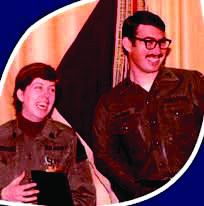
Her time serving resulted in another less subtle shift in life as well — she met her husband Steve. She explained how the men and women’s base was across the street from each other — with the chapel being positioned on the men’s side. One night after chapel service Evelyn asked her future husband if he was going to make her walk back in the dark by herself.
“He said ‘no’ and that’s how that started,” she said laughing.
They were married in 1976 and next year they will be celebrating their 50th anniversary.
A Wife turned Historian
During her time in Germany, Ferchau earned both the Army Commendation Medal and the Good Conduct Medal for exemplary service before leaving the army in 1978. After fi nishing their respective service time, the newly weds settled in Steve’s home state — Oklahoma. The two moved to Stillwater so that Steve could pursue carpentry certifi cation at Meridian Technology Center and Evelyn began a 39-year career at Oklahoma State University.
Evelyn began working as a secretary in the psychology department and eventually became head of the Correspondence Education Division. During this time she played a key role in helping both military members and prison inmates access higher education.
“What I learned through that was the recidivism rate really goes down when they take courses,” she said. “They don’t usually reoffend.”
While working at OSU in 2012, the institute recognized her as the author and editor of “Shawn’s Life Begins” and “Shawn’s Second Year Begins” — two booklets of original poetry that celebrate the birth of her first grandson. Two years later she would be recognized again for completing another booklet titled “Shawn: Years Three and Four”. The subject of the booklets was especially moving when considering Evelyn’s son Ben had died at the age of 15 in a vehicle accident only a few years before.
“We set up a fund in his name and we would go into the high school driver’s training classes and just grow kids up and let them know what can happen,” she said. “We had a fund for 15 years and were able to send kids to music camp with it and we also had a fund for newspaper carriers.”
After 15-years of helping young people, the couple closed out the fund. As Evelyn said, it was time — “it was like my son said ‘Mom, it’s time to stop’”.
In 2016, Evelyn retired from OSU and began dedicating herself to preserving Veteran’s history as a historian for the American Legion Post 108 in Cushing. She has had the tenacity and resolution to document every post commander since 1919, assembled a “Post Everlasting” record of deceased members, and won the Oklahoma American Legion Yearbook contest twice for her meticulous work.
When Evelyn was asked about what Veteran’s Day meant to her she reflected silently for just a moment before saying it was the ones who were on the frontlines that gave meaning for her.
“When I would hear some of the stories from World War II and Vietnam War Veterans how they risked their lives everyday,” she said pensively. “It made me feel so humble to know I was part of that — I was a small part. I supported those who had to face it — they were the real people that were in it.”
She said during the Wednesday morning gatherings held at the Post she has made a point to talk to Veterans she hasn’t met before so that she can learn their stories. She has made it a mission to preserve their history through those conversations without even realizing it. A mission she will continue this Veteran’s Day as she is once again behind a camera documenting another American Legion event.
“I’ve always been a more organized person so the regimentation, that discipline of the military I enjoyed,” she reflected. “There was a camaraderie… My army roommate I’m still in contact with her and that’s a long friendship — it’s the camaraderie.”