
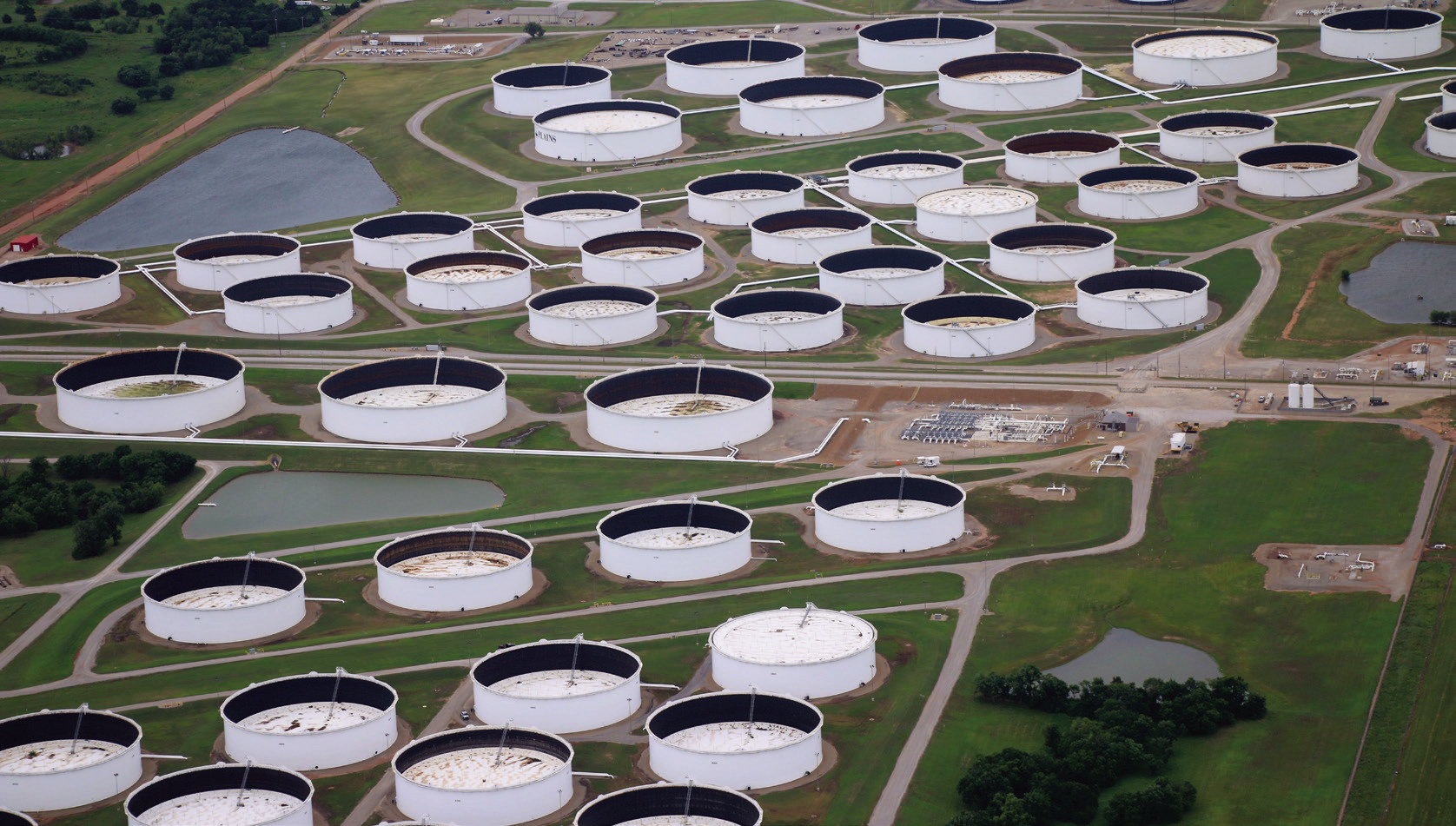
A look inside the low oil stores in the Cushing HUB
CUSHING Although some could say The Cushing Hub storage took a hit when the war Rick Ahrberg, President of Ahrberg Milling Co., believes "I think it goes back before the war, and the reason I say that is because that infrastructure, it had to be laid in the ground time Ahrberg feels that much of the oil product that used to come to Cushing is instead directly going to the Gulf for export and refi ning. "We've got a great asset here, hold 100 million barrels of oil if the nation needs it, if got "I've seen some of the white-collar jobs leave Cushing, go to Houston, and basically, we have a blue-collar workforce, which there's nothing wrong with that, but we do miss that white-collar guidance that was part of our community." Ahrberg noted that he's seen The Cushing Hub, one of the nation's largest oil storage and trading centers, evolve into what appears of "And I just feel this slow, deteriorating he As of July 10, 2026, the oil stock in Cushing is at 20,044 barrels in comparison to 21,408 barrels on July 11, 2025, according Energy Information West Texas Intermediate (WTI) crude oil, the price per barrel and U.S. benchmark, June Every $1 increase in a barrel of oil adds approximately 2.5 cents to the price of a gallon. According to YCharts, as of July 10, The Cushing Hub is currently sitting at around 20 million of the 93 million barrels (barrels the Where The Cushing Hub fl oor barrels sit represents merely 18.6 percent of the hub's storage capacity. If storage levels fall below their minimum volume (tank bottoms), storage facilities are unable to function properly. The Hub is the central pricing and physical delivery point for the WTI crude oil futures traded on The New York Mercantile Exchange Hub means there is less crude oil in reserve, which a ects WTI, or price of gas, though gas prices behind This greatly impacts a company like Enbridge Inc., a Canadian multinational energy infrastructure company that is responsible for the transportation and distribution of energy across North America, whose largest tank farm is located at the Cushing "The world's largest crude oil facility [Cushing Terminal] a vital transshipment point on the energy landscape, and the most signifi cant trading hub for North American crude," said Michael Barnes, media relations about million barrels in shell/storage capacity in Cushing. For customers, we o er expanded storage capabilities and connections in Cushing, which brings more optionality, and The Cushing Terminal handles light WTI, along with medium and heavy crude from various Enbridge and non-Endbridge-owned pipelines. And within Enbridge's liquids network, their Cushing Terminal sits at a key junction while receiving crude oil from the Chicago area via Enbridge's Flanagan South and Spearhead Pipelines, and delivering onward to the United States Gulf Coast via Seaway "As a result, Enbridge's Cushing Terminal often absorbs market fl uctuations in both the upper midwest and U.S. Gulf Coast, providing stability and broader system reliability to our customers," Barnes said. "With respect to WTI, Enbridge's Cushing Terminal serves as an o$ cial physical settlement and delivery point for the NYMEX West Texas Intermediate (The New York futures Our customers also count on our Cushing Terminal to provide operational services to ensure their product meets NYMEX WTI quality Circumstances of the oil industry impact companies like Enbridge as well as its customers. Many of the customers are end users at the gas pumps. And gas prices have risen per gallon, and July's current prices sitting at compared to last year's July average, which were about a percent Below are Oklahoma's average gas prices according to the American Automobile Association. Oklahoma average gas prices July Averages of 2026: Regular $3.5900, Mid-Grade $4.0000, Premium $4.2990, Diesel $4.5070 July Averages of 2025: Regular $2.7600, Mid-Grade $3.1640, Diesel Steve Barsamian, COO of Tank Tiger and a commodities storage broker based in New Jersey, said if the tanks get to the bottom, then people can count that tanks are no being "I guess you can call this what operational capacity looks like for moving product via pipelines in Cushing to the various di erent hubs," Barsamian said. "It honestly can't Theres no incentive for storage at the moment with the backwardation (market condition where the current spot price of an asset is higher than the prices for its future delivery), and yeah, not really gonna see much more things Barsamian said thinking back to last year, there was more contango (when future prices for oil that;s delivered are higher compared to the price of oil currently) in
It honestly can’t probably get much lower than this.
—Steve Barsamian, the Tank Tiger
future markets, therefore people were more willing to take storage. He said according to their data, there’s not much storage demand for Cushing as of now.
“I mean crude as seasonal patterns in it, with the, you know, way refiners consume it,” he said. “Summer – typically refiners are full tilt, they have high utilization, so consumption accrued is high, but realistically now, crude has almost become geopolitical, and what’s tomorrow’s latest headline, so it’s kind of like a world price, if that makes sense.”
Barsamian is referencing the United States conflict with Iran, which began on Feb. 28, 2026, but did the war with Iran truly begin then?
Since 1979, the U.S. and Iran have been in conflict due to the Islamic Revolution toppling of Iran Shah (ruler) Mohammed Reza Pahlavi, an American ally who renationalized its oil industry in 1973.
It has been between then and now that the two countries have clashed time and time again after the Islamic Revolution proved to be victorious in ‘79.
And 47 years later, in February 2026, the U.S. and Israel launched strikes across Iran, which followed with Iran retaliating. It was then on April 13, following back and forth strikes and discussions, the U.S. initiated a blockade on vessel traffic to and from Iranian ports in effort to cripple Iran’s economy and reversing the policy of allowing the country’s oil tankers to travel amid the war to ease pressure on energy prices.
According to the U.S. Energy Information Administration (EIA), it was around mid-March 2026 that the Cushing WTI spot price of dollars per barrel sat at $91.38; as of June 2026, it sat at 85.52 for the monthly average. However, from July 13-17, it sits at 79.20 for the daily spot prices – a jump from the recent weeks of June 29 to July 10 where the price per barrel didn’t overcome 74.56.
This could be related to the fact that the U.S. and Iran came to a preliminary agreement on June 14 where President Trump said this would reopen the Strait of Hormuz. The deal provided enough relief that oil prices, according to EIA, fell from $95 per barrel in the week of June 8 to June 12, and came to $78.94 per barrel from June 22 to June 26.
The preliminary peace deal was formalized on June 15 that was intended to halt fighting for 60 days. President Trump said the deal would restart safe passage of oil tanks through the Strait of Hormuz – a critical shipping route for crude oil – as early as Friday, June 19.
However, a surge of attacks through the weekend between the U.S. and Iran threatened these efforts leading to oil prices jumping back up on June 25 due to a halting of shipping traffic through the Strait. It goes without saying that the U.S. and Iranian officials are still negotiating terms of an official agreement.
On July 5, oil cartel OrganizationofthePetroleum Exporting Countries (OPEC+) announced a plan to increase oil outputs modestly in the next month to bring more oil online. The announcement mentioned a total of seven countries will be expanding oil production by a combination of 188,000 barrels per day come August.
Traffic in the Strait continued to recover despite the fact passages were and are still lower than before the war.
It was said by Ryan Sweet, the chief global economist at Oxford Economics that the durability of the peace agreement between the U.S. and Iran “will determine whether the global economy gets an energy-driven disinflation tailwind or absorbs a second oil shock.”
For Shaun Fechner at Fechner Pump and Supply Inc. of Cushing, he said WTI affects everything in his business.
“Currently, there are only 48 rigs operating in the state of Oklahoma,” Fechner said. “In our area, we have two rigs operating in Creek county. None in Payne or Lincoln Co. Our industry is driven by a couple of factors, oil price and investor money. The investment money is sitting on the sideline and has been for some time.”
As for The Hub, Fechner shares similar thoughts to Ahrberg when it comes to the decline at Cushing.
“Crude inventories at Cushing began to decline around the summer of 2021, and have recorded a steady decline since that time,” Fechner said. “So, although the current conflict between Iran and the U.S. does affect the levels in Cushing, it is not the only primary cause of today’s levels.”
Fechner noted that the oil industry has been characterized by boom and bust times forever, they expect that to continue since being on the roller coaster for 43 years.
Continuing on roller coasters, on July 8, Trump announced that the ceasefi re agreement with Iran was “over.” The U.S. and Iran forces have since been trading attacks despite ‘talks’ between the two continuing.
Iran has since made moves to control the Strait by attacking ships.
As Trump threatened to destroy civilian infrastructure to force Iran to make a deal that would end the war for good and prevent it from obtaining a nuclear weapon, Iranian officials warned that Iran would target civilian infrastructure in nearby countries in retaliation.
Since then, the shipping traffic through the Strait has plummeted due to Iranian strikes on commercial ships despite Trump assuring that the Strait is open.
July 18 marked the eighth night in a row that the U.S. has struck Iran as well as U.S. service member’s lives being taken, which brought a total of 17 American military members killed. This total carries the time since the beginning of the launched attacks on Feb. 28 to July 20, 2026.
From June 15, of intention to halt the attacks on both sides to over a week ago of Trump’s announcement that the cease-fire was no longer in place, the national average gas prices have risen to just over $4 a gallon for the regular average gas price along with $5 for diesel.
Meanwhile, the oil industry and citizens await what the next moves of Trump or Iran will be.
“The issue in the Straits of Hormuz illustrates the importance of energy infrastructure around the world,” Barnes said. “Pipelines are essential to move energy to where it’s needed.”
And I just feel this slow, deteriorating – it’s a big concern.
President of Ahrberg Milling Co.“