
DRUMRIGHT — Drumright Nursing Home’s new memory care unit is more than a secure facility. It’s a sanctuary where safety meets joy, where structure meets soul, and where every resident is treated not just as a patient, but as a person with a story still unfolding.
Drumright Nursing Home’s memory care unit recently opened and Drumright Area Chamber of Commerce members were invited on a tour during the chamber’s monthly meeting, July 8. The area that now houses the memory care unit was once a mostly-forgotten wing used for storage and has now been transformed into a sanctuary for individuals suffering from moderate to severe memory loss due to dementia and other health related issues.
According to Drumright Nursing Home Director Brian Shane, the quiet hallway that is now the Memory Care Unit took seven months to completely revamp.
Designed for
Safety, Built for Comfort
“This is our new Memory Care Unit,” Shane said proudly during the tour. “It’s under 24-hour surveillance — we have cameras everywhere but the residents’ rooms. Everything is code locked and then outside we have a sixfoot fence with three gates — two locked and one key pad entry. The entrance to the unit is always locked, you have to have a code to get in.”
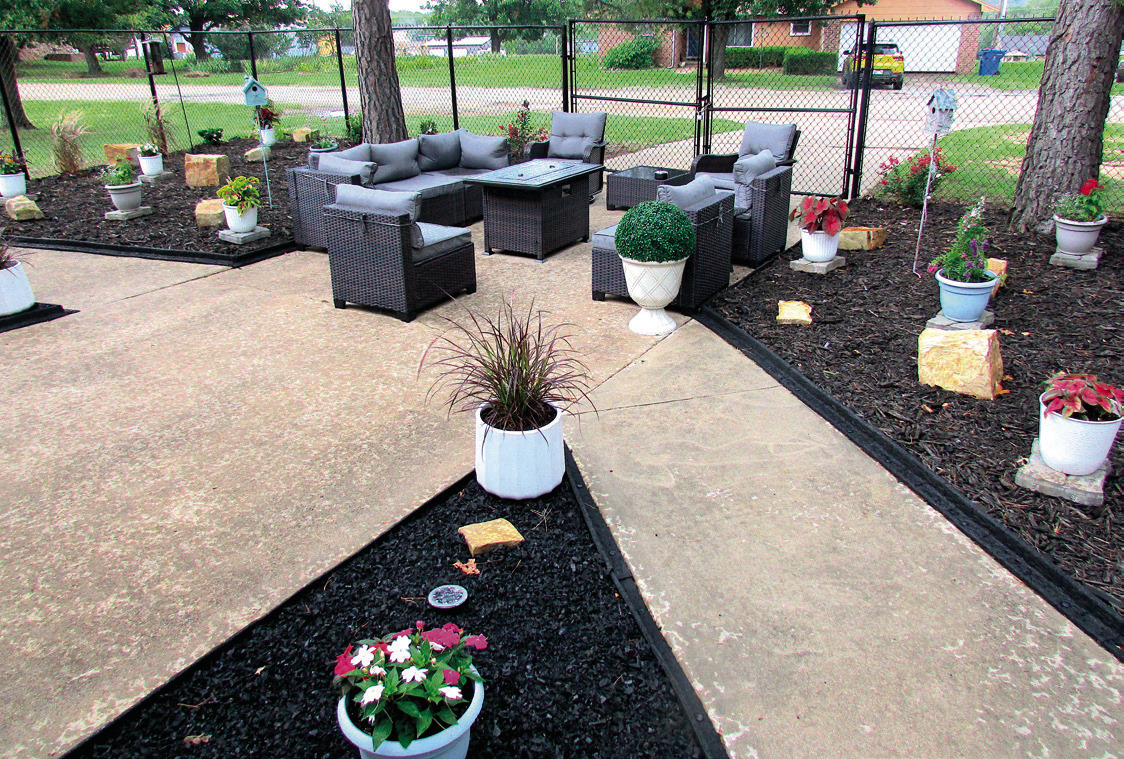
Shane emphasized that while the security measures were for the safety of the residents, the area was still built to be homey and comfortable. One of the major aspects Shane focused on was the outdoor area that was once “just dirt and weeds” as he explained it.
“The residents love going outside. That’s one of their favorite things — so in good weather early in the morning or in the evening, when the weather’s nice we take them outside because they love sitting out,” he said. “We’re really happy with it. I’m excited. I think it’ll be a big plus for Drumright.”
The area features a gathering space, sitting areas, shade trees, and vibrant potted plants throughout the landscape. Shane said at night, lighting in different colors made the space more visually pleasing. The outdoor area is a major bonus in unit resident’s morale, according to Unit Supervisor Champane Walters.
“Our first day that we opened up, one of our residents was sitting outside singing on the lawn furniture, I swear. She was just singing and I was sitting there looking at her, and I’m like, oh, my gosh like, you’re so happy and that’s what you want — that’s exactly what you want,” said Walters.
Inside are four private rooms and three semiprivate rooms that can be adjusted to accommodate a maximum of 16 residents. There is a dayroom available to residents for napping, chatting, or watching TV.
“We’re really happy with it — I’m excited. I think it’ll be a big plus for Drumright,” he said.
Beyond the level of comfort provided by the environment, staff members have also been specifically chosen for the unit. Walters was handpicked by Shane and she went on to handpick the additional staff members who provide individualized care for residents.
Walters, who began working at the nursing home as an overnight charge nurse about a year ago, said she never anticipated she would be leading the unit, but was happy to take on a role that has been of interest to her for some time.
“I’ve always been really interested in dementia the way the disease affects your brain,” she said. “And then Brian had mentioned that he was thinking about opening up a unit. I said that I would be interested in working back there. Never did I think that he would want me to run it — I was really surprised when he brought me in his office and asked me if I wanted to head it up. It was really cool and it’s been great.”
Currently, there are three nurses caring for five residents.
“They’ve all gone through specialized courses in dementia so they are all certified in courses centered on dementia and Alzheimer’s and that is a big benefit,” said Walters.
She went on to say one of her favorite aspects is the patient-centered approach and one-on-one care that is afforded the residents in the unit.
“Everyone progresses in dementia differently and back there, because it is so small and kind of tight-knit, it’s not so large, you can literally create a care plan, day-to-day activities that are centered to that specific patient, where they’re at in their dementia and you can just cater to them,” Walters explained.
Each resident has the opportunity to take part in activities that are designed to help occupy their hands and minds to keep them calm and maintain their mental health, according to Walters. Activities like coloring, scrapbooking, and floor puzzles are more than just pastimes for the residents they are tools for communication and connection.
“With the scrapbooking, you can take pictures of their family and put them in little scrapbooks and when they do get where they’re agitated that they can’t remember — they can’t remember why they’re here, what they’re doing here — you just open up their little book and show them this is who you are, this is who you were married to, this is your grandkid and they love it,” she said. “As long as they can stay stimulated they can stay free in a way. That keeps the behaviors down whether they’re emotional behaviors where they start crying and they don’t understand why they’re here, what they’re doing or the aggressive behaviors.”
Redirection not restriction
Walters said she has learned to recognize that agitated residents are usually just having trouble communicating their needs and that working to meet those needs is what the staff focuses on.
“A lot of times with dementia, your patients pace and they have no idea why they’re pacing but they have some type of unmet need and we can focus on that one patient and figure out what that unmet need is,” she said.
Walters said, each nurse has received special training to care for residents facing memory loss.
“One of the hardest parts, I think, for families to deal with, is some people, as they progress in dementia, they can get violent and as a family member you don’t know what to do — you don’t know how to redirect. We do.” she said. “Here in this memory unit, I’m really proud of the education the staff has had on redirection. Some of the residents are on certain medications that can help but really, I mean, we push activities instead of just medicating them.”
Finding ways to keep residents stimulated, keeping activities available, and keeping an eye out for unmet needs has been the primary goal of the staff. Additionally, providing a level of freedom to unit residents has cut down negative reactions, says Walters.
“I am a big patient/resident advocate — they have their rights and in the memory care unit they just have even more. . . You tell me you want to go outside, I take you outside and they love it,” she said. “I am confident enough to say we have reduced aggressive behaviors nearly in half by being back there and by letting them have the option to go outside and to roam where they want.”
The entirety of the unit has been organized with care and connection in mind.
A Place for
Family
Family visits are handled with personal attention, and residents are always introduced gently to ensure they feel safe and at ease. Walters explained visitors often contact her directly when they want to see a resident in the unit.
“I let them in and we walk them down to the resident they’re seeing and most of the time the resident will at least recognize that they somehow know the visitor — they might not know the name but they know the face,” she said. “We’ll tell them who’s visiting and make sure they are okay with the visit — sometimes they are, sometimes they’re not.”
An area for end-of-life care is also situated within the unit designed with loved ones in mind. According to Walters, there is a designated hospice room set up near the entrance of the unit that offers families a quiet and private space during a residents’ final stages.
“It’s got a coffee pot in there, it’s got some really comfortable chairs for family to sit in. That way, when residents do start to decline and it comes time for them to start passing on, the family can stay in a private room with them,” she said.