
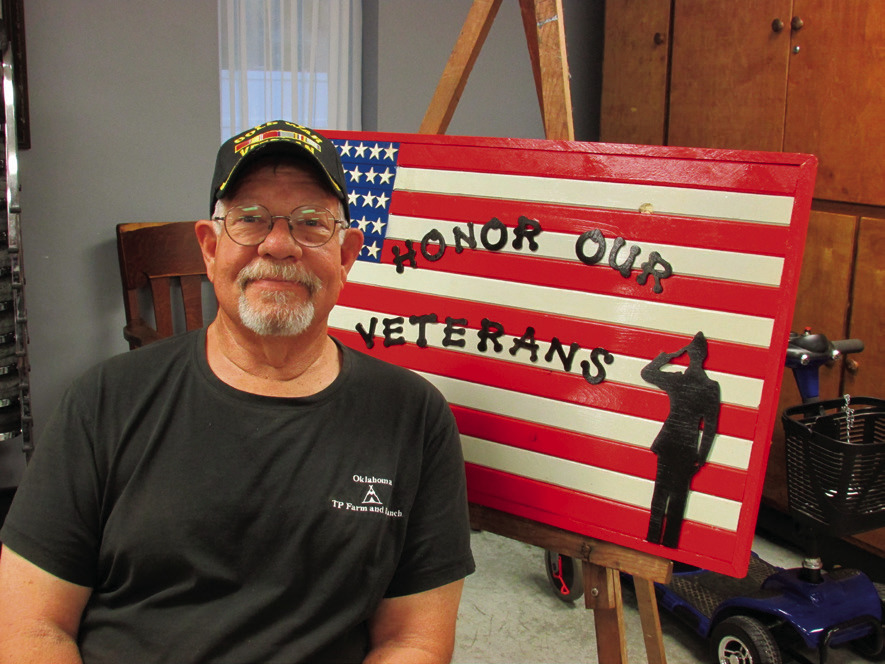
America’s story has been written by men and women who have served — safeguarding our freedom for the past 250 years. However, it’s not just the ones written in history books who are responsible for the immense privilege we now celebrate. There are countless service members who have been unseen as they protected us from behind the curtain. Tim Potter is one of them.
Unlike veterans whose experiences were marked by televised battles or highly publicized campaigns, Potter served during the Cold War — a decades-long conflict defined by secrecy, intelligence gathering, and the ever-present possibility of nuclear war. Much of what he did could never be discussed openly at the time, nevertheless, it was work that helped keep us safe during one of the most uncertain periods in modern history.
“The Cold War was a long war. It was actually a political war,” Potter said. “There was quite a few people that died during the Cold War but nobody ever got to hear about it.”
Potter entered the U.S. Air Force in 1977 — serving four years at Malmstrom Air Force Base in Great Falls, Montana — he was an administration specialist with the Plans Intelligence Division. While serving he helped train crew members who were responsible for America’s nuclear deterrent — an enormous responsibility.
“We taught crew members how to launch nuclear weapons,” he said. “Training was quite extensive… There are a lot of sequences that go into it before you actually launch a nuclear weapon. There are safety protocols. You can’t have two people decide they’re going to launch it. Everything has to be coordinated.”
During the height of Cold War tensions, his team closely monitored Soviet activity and continually updated security procedures as world events unfolded. While Americans watched events like the Iranian hostage crisis on television, personnel behind the scenes were responding in ways few civilians ever realized.
“Anytime a big event happened in the world, then we had to change everything,” Potter said.
The work demanded precision, trust, and absolute confidentiality. There was no camera crew shining a light on personnel as they scrambled through daily operations in secret. But there they were keeping delicate information from coming into public view to keep us safe and our freedoms intact.
“We had to make sure all of our secret and top-secret documents stayed that way… There was a lot going on during that period nobody knew about,” he said. “A lot of this stuff didn’t, couldn’t come out until long after.”
Potter’s service to America didn’t end when he took off the Air Force uniform.
After leaving active duty, he went to work at the Pantex Plant outside of Amarillo, Texas. He explained the facility was responsible for the final assembly and disassembly of every U.S. nuclear weapon. He eventually became a maintenance electrician. At 40, he embraced an entirely new challenge by joining the plant’s fire department and later serving as a fire captain, protecting the thousands of employees who worked at the highly secure facility.
Military service was a family tradition, according to Potter, stretching across generations. He said his father served in the Army during the Vietnam era. His oldest son built a career in the Navy, retiring as a chief petty officer, and his grandson now wears the uniform of the U.S. Marine Corps.
“We’ve got the Army, Air Force, Navy and Marine… We just need the Space Force and I guess, Coast Guard,” he humored.
Ironically, his own military career began because someone told him not to pursue it. He recounted how he was discouraged from speaking with a military recruiter while he was working for what is now Tyson Foods.
“They told me not to go because it’d be like looking for another job,” he said. “Me being a teenager then, well, when you told me not to, that’s when I’ve got to do it.”
Today, Potter’s battlefield looks much different — an 80-acre hobby farm where cattle and chickens have replaced briefings and security. In 2020, Potter retired to Cushing where he operates Oklahoma TP Farm and Ranch.
“I’ve learned a lot,” he said. “I’ve learned that I don’t know anything.”
Luckily, being adept in constantly changing protocols has prepared him, at least somewhat, for constantly changing days on the farm. He said the work never truly ends whether that means repairing fences, clearing storm-damaged trees, or tending to the livestock.
“There’s always something to do,” he said.
Even so, he treasures the quiet.
“The farm life is just great,” Potter said. “You can’t hear the traffic. You hear the coyotes at night or maybe an owl.”
Community service remains just as important to him as military service. Potter regularly donates eggs from his flock to the American Legion Post 108 for their Wednesday morning veteran breakfasts, volunteers through First Baptist Church, and continues looking for ways to serve his neighbors.
“I enjoy helping the community,” he said. “I always have.”
As America marks its 250th anniversary, Potter’s story is a reminder that the nation’s history is built not only by those who fought on highly publicized battlefields, but also by those who stood watch during quieter conflicts — men and women whose dedication helped preserve peace even when their contributions remained largely unknown.
For every famous chapter in America’s story, there are thousands more written by ordinary citizens who answered the call to serve — citizens like Potter.