
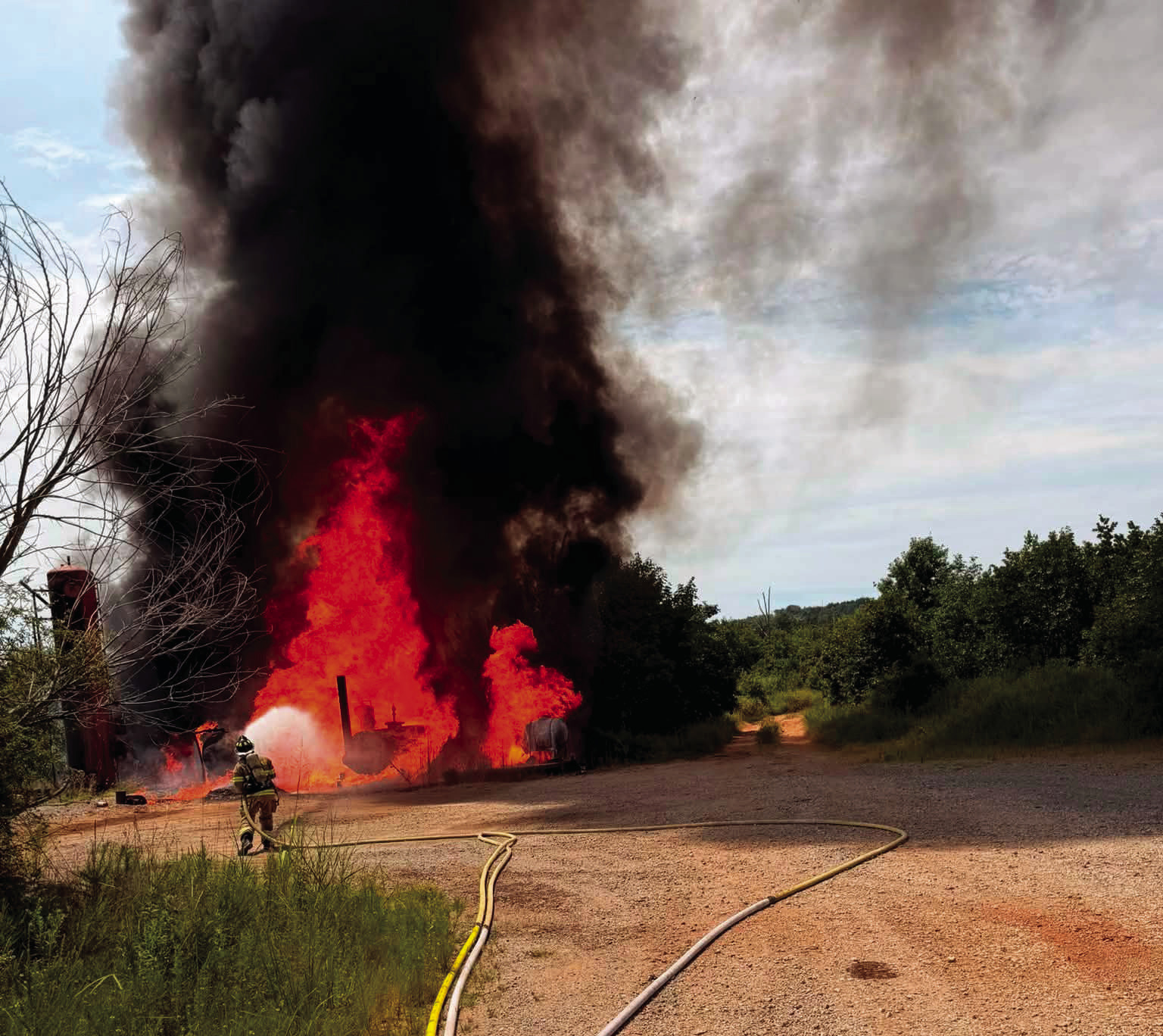
After responding to a recent tank battery fire a number of firefighters suffered heat-related illnesses with one spending half a day hospitalized.
North 48 fire department was dispatched to the incident on County Rd. 5500 north of Terlton on July 28 around noon, according to Fire Chief Keith Buntin. While the initial fire was under control within a few minutes, things changed for the worse quickly.
'Incidents like this show just how quickly conditions can change. What appeared to be under control within minutes turned into a much larger and more dangerous incident when additional oil began feeding the fire,” the department wrote in a social media post.
Buntin recounted a tall separator had an exposed line that melted and began to spill a thick type of crude known as Brent Crude or basic sediment and water in oil production.
“It started back flowing through one of the flow lines and just completely broke our foam blanket,” he said. “We kept trying then all of a sudden it took off again… When it all broke loose big 80 to 90-foot flames took off.”
The severe heat damaged one of North 48’s fire engines even though it was parked approximately 100 feet from the burn.
“We believe right in the middle of firefighting, our engine shut off and it melted,” said Buntin.
He explained superheated air on top of 100-plusdegree temperatures that day likely caused melted wiring harnesses, damage to portions of the radiator and radiator hose, and the engine block to crack when flames unexpectedly intensified.
The intense heat also impacted firefighters during the response. Buntin said there were several who had minor heat-related injuries with one department member who initially declined treatment and opted to continue fighting at the time having to go to the hospital a few hours later.
“He was there for probably 12 to 14-hours,” said Buntin. “He’s good now, he was released.”
Beyond extinguishing the flames, work to prevent contaminated runoff had to be done. Buntin said the oil company supplied a bulldozer and constructed dikes to divert water and oil away from nearby waterways. Representatives from the Oklahoma Department of Environmental Quality and the Oklahoma Corporation Commission responded to the scene as part of the environmental response.
During the response, much of the departments available foam was exhausted. Buntin said North 48 used approximately 60-gallons of its own foam while mutual-aid departments from Terlton, Jennings, Peninsula, and Cleveland supplied additional foam bringing total usage to more than 100 gallons. In addition to replenishing its foam supply, the department now faces replacing more than $9,000 worth of bunker gear contaminated by crude oil during the firefighting effort, along with several sections of hose that were also exposed, and either replacing or repairing the damaged 1991 fire engine which initial inspection indicated repairs to exceed $10,000, according to Buntin.
As of Aug. 3, Buntin said the department was still awaiting a final estimate but replacement parts for the aging apparatus are becoming difficult to find since the turn of the century. If the truck cannot be repaired, replacing it would be significantly more expensive — Buntin estimated even a used fire engine from the beginning of this century could cost between $50,000 and $150,000.
While no final decision had been made and no formal fundraiser had been announced, Buntin said the department may seek public support if insurance does not fully cover the damaged engine and other losses. He added that North 48 Fire Department operates as a nonprofit 501(c)(3) organization which allows donations to be tax deductible.
'We're trying to figure out everything,' Buntin said. 'It's a very expensive fire.”
While equipment can be repaired or replaced, department leadership expressed gratitude that every firefighter returned home safely.